Home Workout Routines Inspired by Professional Athletes
Professional athletes train with purpose. Every sprint, jump, lift, and recovery session helps them perform better on the field or court. You can bring the same idea into your home workouts without needing expensive equipment or a professional training facility. The key is to focus on functional movements that build strength, speed, balance, mobility, and endurance. In this guide, we’ll explore home workout routines inspired by professional athletes that you can adjust to your fitness level and do from home.
Why Bodyweight Training Actually Works
There’s a common assumption that real strength requires a barbell. The research doesn’t back that up. Studies over the past decade confirm that bodyweight training can build muscle and strength comparable to traditional weightlifting, as long as the intensity is sufficient. Progressive overload, the principle behind all strength gains, is achievable without equipment by pushing closer to muscular fatigue.
Bodyweight training also has a specific advantage for athletic performance. Because you’re limited to your own weight, you’re forced into more full-body movements, which builds core strength and improves how well you transfer power from your lower body to your upper body. That’s a big part of what makes an athlete look athletic, not just strong in isolated muscles.
The 6 Movement Patterns Pro-Style Training Covers
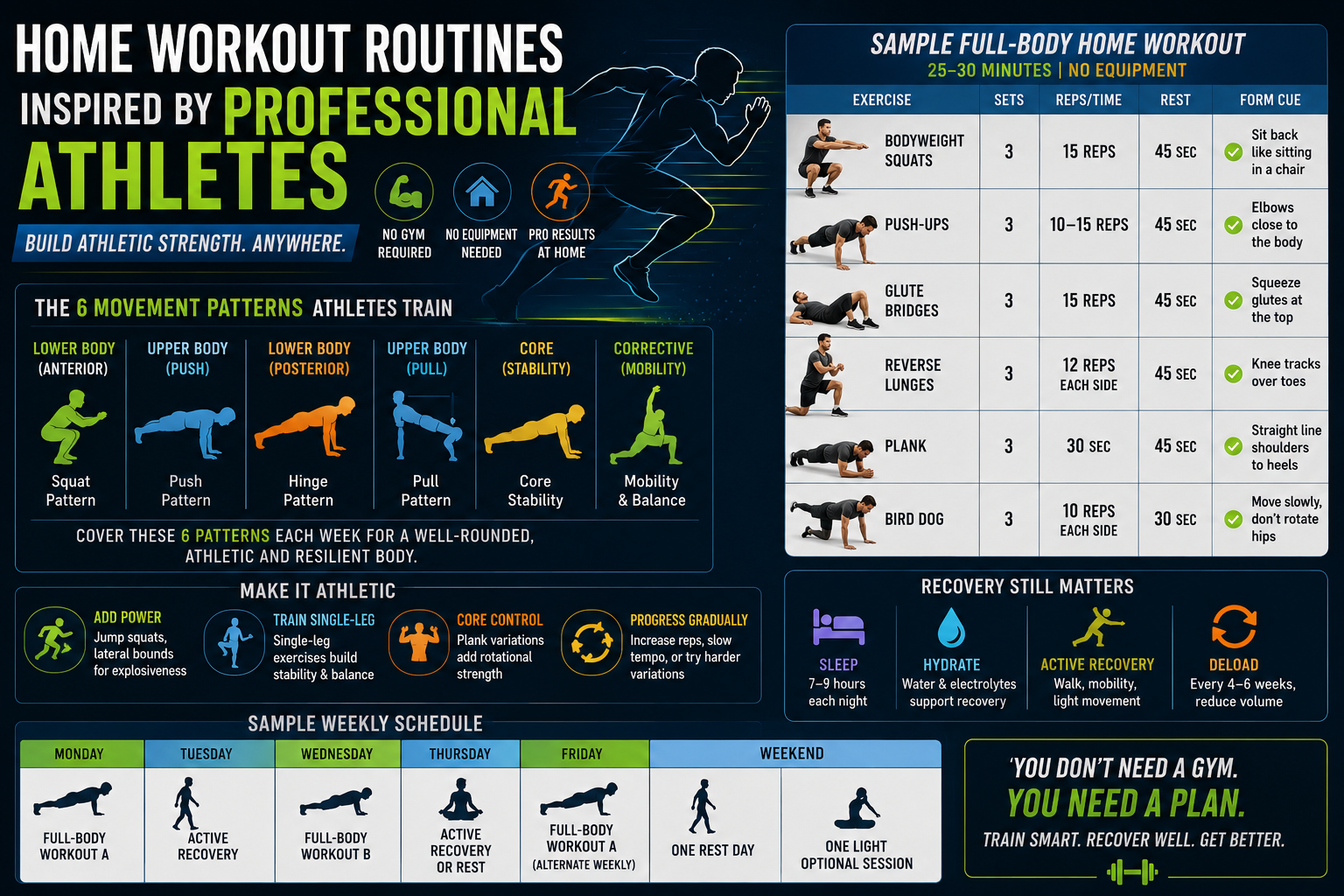
Elite strength programs aren’t built by exercise. They’re built around movement categories. A well-rounded bodyweight program covers six major functions: lower body anterior chain (quads), upper body push, lower body posterior chain (hamstrings and glutes), upper body pull, an abdominal circuit, and a corrective or mobility exercise.
Hit all six across a week, and you’ve covered what a pro strength program covers, just without the equipment.
A Sample Full-Body Home Workout
Here’s a routine that covers those six patterns in one session. A full-body session like this typically runs 25 to 30 minutes, including warm-up and cool-down, and needs nothing more than a mat and, optionally, a light pair of dumbbells.
| Exercise | Sets | Reps/Time | Rest | Form Cue |
| Bodyweight Squats | 3 | 15 reps | 45 sec | Sit back like sitting in a chair |
| Push-Ups | 3 | 10-15 reps | 45 sec | Elbows close to the body |
| Glute Bridges | 3 | 15 reps | 45 sec | Squeeze glutes at the top |
| Reverse Lunges | 3 | 12 reps/side | 45 sec | Knee tracks over toes |
| Plank | 3 | 30 sec | 45 sec | Straight line from shoulders to heels |
| Bird Dog | 3 | 10 reps/side | 30 sec | Move slowly; don’t rotate hips |
If a movement is too advanced, scale it down—beginner variations like glute bridges and chair squats build the same foundation before you progress toward lunges and eventually more advanced moves like jumping lunges.
Making It Athletic: Add Power and Single-Leg Work
A basic bodyweight circuit builds strength. To train the way athletes train, add two things: explosiveness and single-leg stability. Most sports injuries and most athletic movements happen on one leg, not two, so training only bilateral squats and lunges leaves a gap.
Once the exercises above feel manageable, layer in:
- Jump squats in place of a set of regular squats for explosive power
- Single-leg glute bridges to build the unilateral stability sport movements demand
- Lateral bounds (side-to-side jumps) to train the change-of-direction pattern central to field and court sports
- Plank shoulder taps to add rotational core control on top of static holds
This is the same logic behind the run-stop-turn-brace-jump-land pattern elite athletes train for. You’re just applying it with body weight instead of a training facility.
Structuring Your Week
Pro-style bodyweight programs don’t repeat the same workout every day. A common structure alternates two different full-body workouts across a Monday-Wednesday-Friday schedule, swapping which one comes first each week so both get equal rotation.
This isn’t arbitrary. It ties directly into what we covered in the science of recovery: muscle needs roughly 48 hours to repair before you load it again. Alternating two sessions across non-consecutive days respects that window without requiring a rest day between every single workout.
Recovery Still Applies at Home
It’s easy to assume that because you skipped the gym, you skipped the recovery conversation too. You didn’t. The same principles apply:
- Rest 2 to 3 days a week: Space them around your hardest sessions.
- Sleep 7 to 9 hours: This is when much of your muscle repair occurs.
- Use active recovery on off days: Take a walk or do light mobility work instead of another workout.
- Deload every 4 to 6 weeks: Reduce your training volume and intensity, even when training at home.
Training harder at home doesn’t override the biology. If anything, home training makes it easier to accidentally skip rest days, since there’s no commute forcing a natural break in your schedule.
A Sample Weekly Schedule
- Monday: Full-Body Workout A
- Tuesday: Active recovery (walk, mobility)
- Wednesday: Full-Body Workout B
- Thursday: Active recovery or rest
- Friday: Full-Body Workout A (or B, alternating weekly)
- Weekend: One rest day, one optional light session
FAQ
1. Can you really get athletic results with no equipment at all?
Yes, as long as you push the intensity high enough. Progressive overload without weights usually means adding reps, slowing the tempo, or moving to a harder variation of the same exercise.
2. How is this different from a normal home workout?
The structure follows the same movement-pattern logic pro strength programs use, and adds single-leg and explosive work most generic home routines skip.
3. Do I still need rest days if I’m only using body weight?
Yes. Muscle repair depends on recovery time, not on whether you used a barbell or just your body weight to create the training stress.
Conclusion
You don’t need a gym to train like an athlete. With the right movement patterns, progressive challenges, and enough recovery, bodyweight workouts can build strength, stability, power, and control. Start with the basics, progress gradually, and stay consistent. Your living room can be the starting point for stronger athletic performance.
Related reading
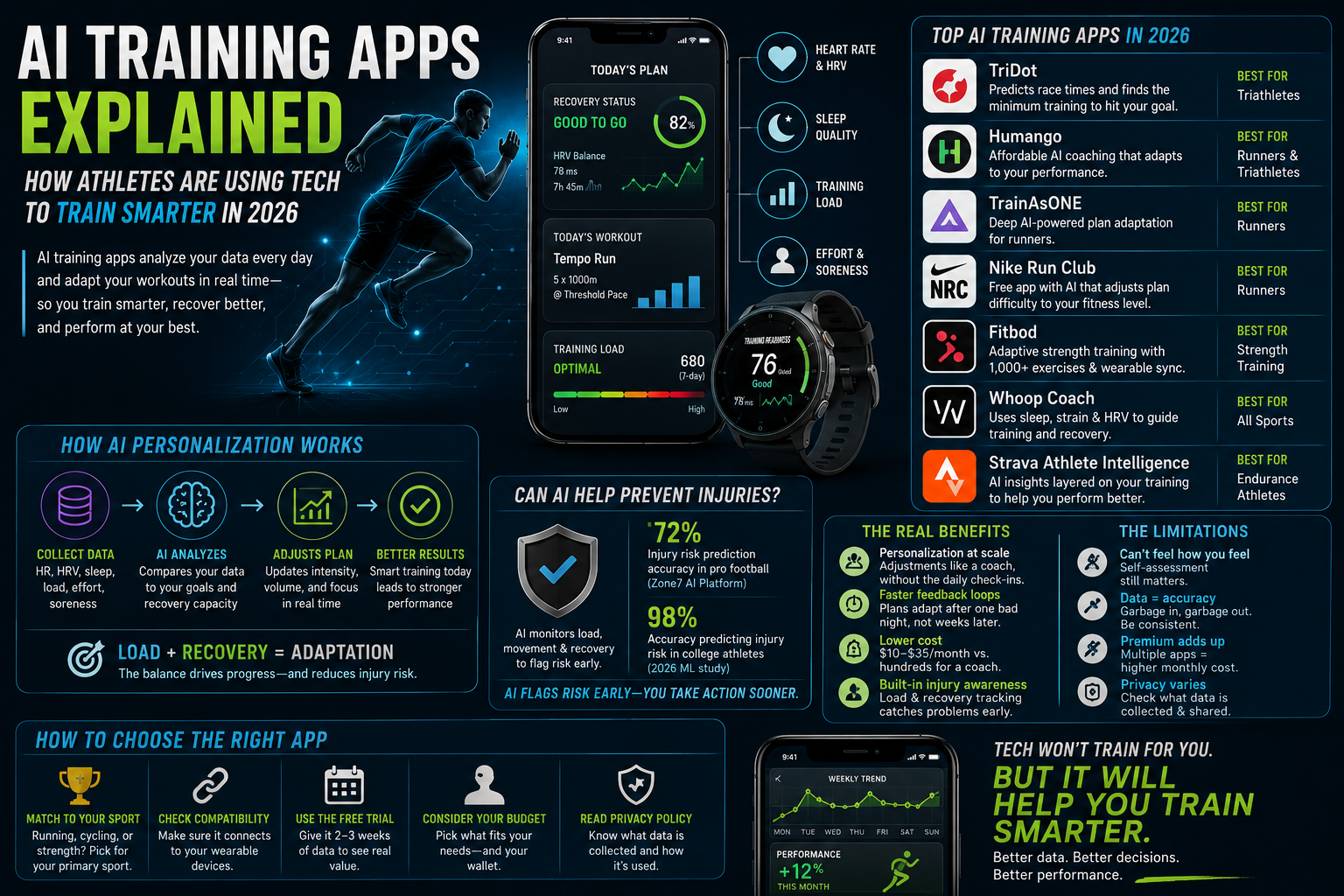
AI Training Apps Explained: How Athletes Are Using Tech to Train Smarter
Athletes used to train off a printed plan and a stopwatch. That plan didn’t know if you slept badly, missed a session, or showed up already…
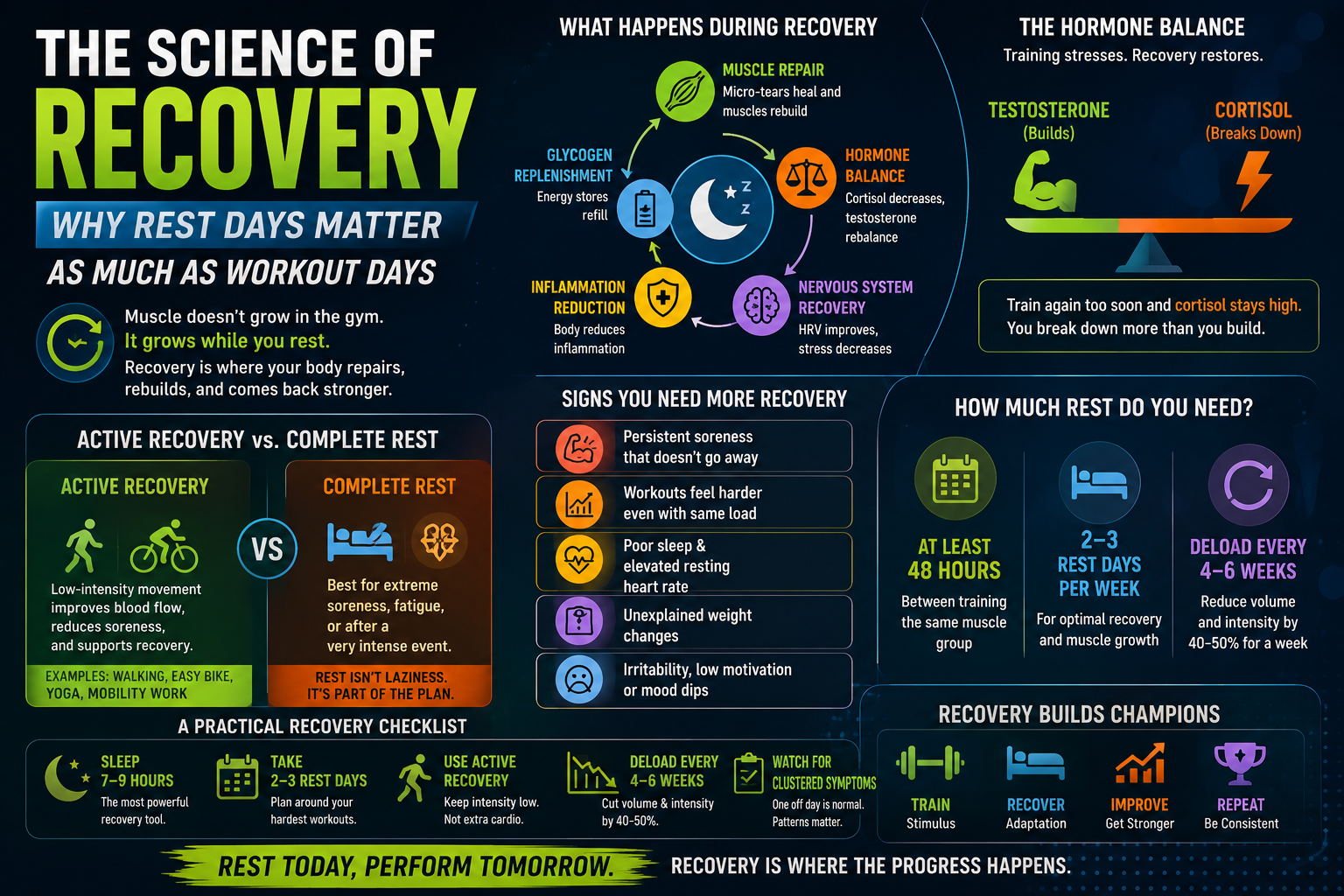
The Science of Recovery: Why Rest Days Matter as Much as Workout Days
Skip a rest day, and you feel like you’re getting ahead. Take one, and it can feel like standing still. Physiologically, it’s the opposite. Our post…